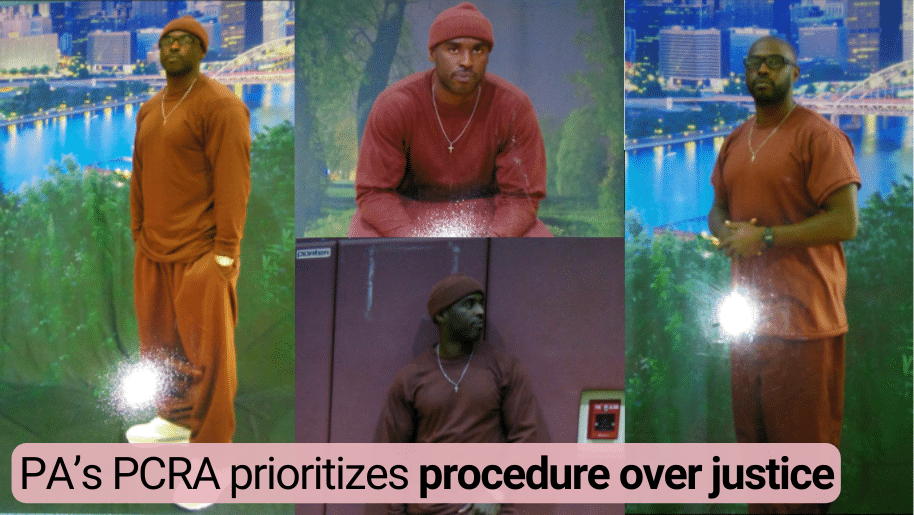
The following was written by Pierre Pinson (pictured above), a person incarcerated at SCI Fayette. He read it over the phone; that was recorded and it is transcribed here, though maybe not with 100% precision due to the patchy audio quality of the recording.
I want to first acknowledge that by me saying that the Post-Conviction Relief Act is unconstitutional, it does not make that a legal reality. Courts have upheld the Post-Conviction Relief Act as constitutional. The lived reality, however, is much different. My claim is that the PCRA is apartheid legislation because of how it functions in practice.
In Pennsylvania, the PCRA is the sole method to challenge convictions and for the defendant to file a direct appeal. And of course, the PCRA covers ineffective assistance of counsel, newly discovered evidence, and constitutional violations. In all favor, that sounds fair and reasonable. But the lived reality is that the PCRA violates constitutional principles in the way it is structured and enforced.
The PCRA systematically denies meaningful post-conviction review, especially to poor, Black, and brown people, creating a two-tier justice system. Probably the greatest complaint about the PCRA is its one-year statute of limitations that override constitutional right. The history of how the statue of limitations came to be is steeped in racism associated with Bill Clinton’s crime bill, which he supported by using a racist propaganda, the “superpredator”, which so embarrassed Americans.
Around the same time, the Antiterrorism and Effective Death Penalty Act was passed, and it created the one-year statute of limitations for terrorists. It wasn’t long until it applied to all incarcerated people, who, of course, are disproportionately Black and brown.
The one-year limitation is what they call an affirmative defense. It is used to ensure judicial finality instead of state-guarded justice. In many instances, the time bar creates a constitutional conundrum as it leaves a class of people without an avenue to remedy violations of the United States and Pennsylvania Constitutions. For instance, in 2014, in Commonwealth v. Newman, Pennsylvania courts reiterated a ruling in Alleyne v. United States, which stated that 42 Pa. C.S.A. 9712, the mandatory sentencing statute, was unconstitutional in its entirety. It is black letter law, but an unconstitutional statute is ineffective for any purpose. It is as if the statute were never enacted.
As a result of that ruling, certain cases were remedied, but the courts declared that the ruling did not apply retroactively. The result was a class of individuals sentenced unconstitutionally.
These folks have been abandoned. The legislators have not offered correction; the executive branch has not offered pardons; and the judicial branch has not provided remedy for those individuals who are disproportionately poor, Black, and brown.
The conundrum lies with the fact that the general assembly has a constitutional obligation to remedy a statute like this. And at the same time, the PCRA statute bars remedies for such violations. At the same time, the lower courts retain an inherent authority to remedy these violations pursuant to 42 Pa. C.S.A. 9542, a provision within the PCRA statute that reads,
“This sub-chapter is not intended to limit the availability of remedies in trial courts.” This language points to the trial courts’ inherent authority. That inherent authority can be used to correct illegal sentences that were imposed by the trial court.
For support, I would point to one Pa. C.S.A. 1921 and 1922, which state, “The General Assembly does not intend a result that is absurd or unreasonable, and the General Assembly does not intend to violate the constitution of this commonwealth.” Still, judges will not invoke this inherent authority, and instead allow the PCRA to obstruct their judicial function.
To add to that, actual innocence is not enough for the PCRA; it must also fit into narrow statutory exceptions. This is constitutionally backwards. A legal system that prioritizes procedure over innocence has abandoned justice, and has become a danger to those most vulnerable to injustice.
My observation of the PCRA as apartheid legislation is based on outcomes. People who apologize for the Post-Conviction Relief Act will say, “That’s not the PCRA’s intent.” But we all heard the saying that “the road to hell is paved with good intentions.” The facts are this legislation disproportionately impacts Black and brown people and creates a two-tiered justice system. Wealthy people can afford an investigator, experts, and elite appellate attorneys at their earliest convenience. Poor people, on the other hand, often discover Brady violations, forensic errors, policemen misconduct after the post-conviction deadline expires.
This results in one group getting relief and another locked out permanently. That is apartheid separation by class and race, and it is impossible to ignore PA’s stark racial disparities in sentences leading from wrongful convictions. Those are the populations most harmed by the PCRA’s procedural farce.
When a law predictively protects convictions obtained through racial bias, it becomes racially oppressive. When a system readily prioritizes systemic efficiency over true innocence and accountability, it mirrors apartheid systems where legal orders are served even when injustice is blatant.
That is our lived reality, and that is the PCRA in Pennsylvania.